Showing posts with label pets. Show all posts

Sunday, 13 July 2014

July Poultry Update


We now have four chickens, as we've taken in a refugee from a friend at work whose new dog ate all of her chooks, but one. So our flock welcomed Sooty last week, who is a grey silkie cross. I'm not sure how old she is, nor do I expect her to lay for some time- if at all- after the trauma she's been through (she was rescued from the jaws of the dog). Sooty is a very friendly chook- quiet, calm and able to be picked up for a cuddle. 

In other news, Chicken Dance has started to lay! In the past fortnight, I've gotten six small eggs. At first, I only suspected it was her, as she is the biggest chook. Then I caught her 'in the act' one afternoon. I'm now enjoying delicious home-produced eggs and I couldn't be happier.


The Ladies have now settled into their routine. Every morning I let them out of their house, re-fill their water and put out some feed for them. They then scratch in the garden all day. Of an evening, when I get home from work, the chooks are in their house, ready for bed. All I have to do is shut the door to make sure they are safe overnight. 


I still feed the Guinea Fowl every morning over by the goat paddock. Unfortunately, if I dont turn up with their feed before 8am, they come up to the house looking for it and making a racket. The perfect alarm, in case I wanted to sleep in on a Sunday. The chickens and the guineas get along well. That is, the guineas basically ignore the chickens and the chickens ignore the guineas. 


Wednesday, 9 July 2014

Family Visits


We are lucky enough that my brother, sister-in-law and nieces live only an hour and a half away and therefore regularly come to visit. The girls ran around like crazy outside, playing with Pipi, the dog and trying to catch the chickens to cuddle. They played outside for most of the day, on the trampoline and on the various scooters and bikes we have.


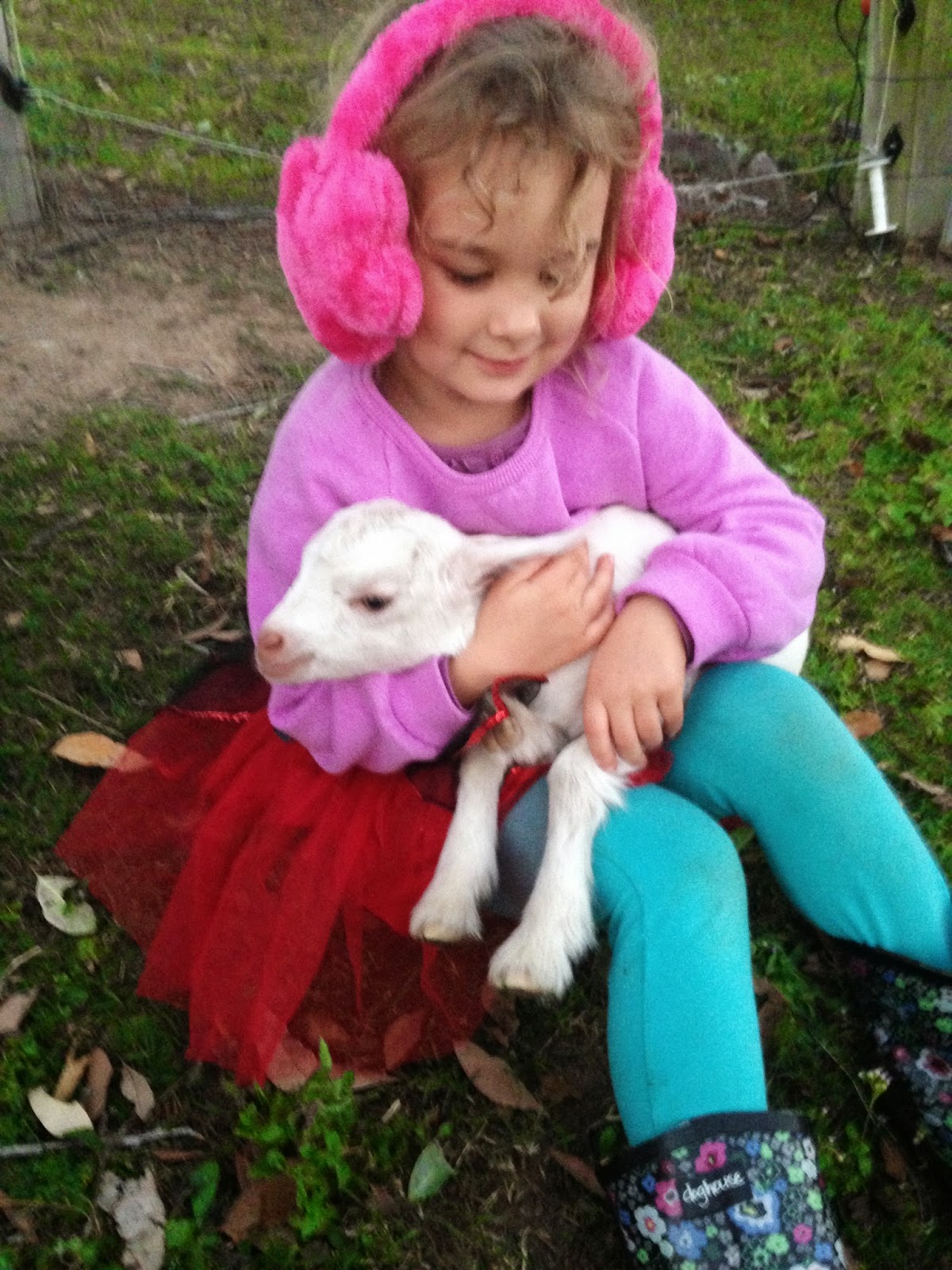
In the afternoon, I took the girls out to visit the goats. The baby goats were a huge hit. The girls loved chasing, catching and cuddling the babies. The goats on the other hand, weren't impressed.

Gigi, Asha and Lily
 I caught a kid for Asha to hold and she cuddled it for about 20 minutes. Lily managed to sneak up to and catch her own kid to cuddle.
Lily named this kid 'Rosy'

Tuesday, 24 June 2014

They're Here! This seasons baby goats


The nannies have started to kid and this seasons baby goats have slowly been arriving one by one. Gigi is so excited by the kids, every time we go out to look at them or feed the mothers, she tells me "I love the baby goats Mumma". At first she was a little confused about where they had come from, she kept asking me if Poppa had bought them. I explained that they grew in their Mumma's tummy and then they were born. She now picks the kids up and tells them "You are so cute, you were in your Mummas tummy".


The nannies and kids were isolated in the 'nursery pen' for a few days to ensure the babies were feeding correctly and that the mothers were looking after their offspring. In past years, the mothers (especially first time mothers) have the kid, then walk away. Other times, they've had the kid, looked after it for a week or so, then just given up. After loosing a few kids over the years, I have learnt the importance of separating out the mothers.  If you don't keep the nannies and kids in a separate and smaller paddock to the main herd, it is harder to keep an eye on them and identify problems as they arise. Also, in a small pen, the kids are easy to catch and pick up for cuddles. By about four days old, they are very fast and hard to catch. 


So far we have had four kids born to four nannies. One female kid and three males. The males will be castrated to be whethers, which I will write about in a future post, at the time. Whethers are much easier to handle, don't smell and are much easier to sell on to others. Also, with a small herd its important limit the number of billy's' to prevent fighting between themselves and also to prevent inbreeding in the herd.


There are another three nannies due to kid sometime in the next two or three weeks. Two of the nannies usually have twins, so I'm expecting twins from them again this year. The other nanny is pregnant, but looks small, so I think she will only have a single kid. 

Chook Update: Settling in Nicely


The lovely ladies took up residence at my parents house three weeks ago and they are settling in nicely. Every morning they are let out to wander the house yard and every evening they put themselves away in their chook house. 


To start with, they limited their exploration to the gardens around their chook house, but everyday they explore a little further afield. My suspicions of their personalities have turned out to be correct- Fly (brown) is quiet and friendly. She is the easiest to catch and seems to enjoy a cuddle. Chicken Dance (white) is big and docile, whilst In The Box (black) is quick and crafty.


As I predicted, Gigi loves the chooks. Fly has emerged as Gigis favourite, possibly because she is very quiet and doesn't struggle when being held. She is also much smaller than Chicken Dance, whose larger size is a little intimidating for Gigi at the moment.


For myself, I just love watching the girls as they wander around the garden, scratching in the mulch and the grass on their hunt for insects. I find it incredibly relaxing and endlessly interesting watching them do their thing. 

Wednesday, 11 June 2014

Introducing some Lovely Ladies

The Lovely Ladies
As mentioned in previous posts, my parents wanted some chicken for their lovely fresh eggs. My dad built a small coop and I built a water trough, a feeder and a nesting box. I then purchased three cross-bred backyard chickens from the local markets. I chose cross-breeds because they are supposed to be quite hardy and as mentioned, its been a while since my parents or myself have had chickens. I also chose cross-breeds because they are much cheaper than pure breeds- $10/bird as opposed to $30-40/ bird. 

Fly
Gigi is very interested in the chickens and was very excited to give them names. She has chosen 'Chicken Dance' for the white chicken, 'Fly' for the brown chicken and 'In the Box' for the black chicken. 

In the Box
 Already they have their own strong personalities showing through. 'Fly' is very quiet and gentle. I think she will come for cuddles and pats soon enough. Her colours are lovely and she has an interesting hair-do. 'In the Box' is a small bird, very observant and wary. I think in time she'll be friendly enough, if it suits her. I also have a feeling that she'll be the trouble maker and is the most intelligent of the three. She has lovely black feathers, with a colourful shine in the sun.  Chicken Dance is the biggest girl and is at the top of the pecking order. She is big, loud and a bit dopey. She is pure white with a large comb and wattles.

Chicken Dance
The girls will be let out to free-range this weekend and I am looking forward to watching their antics in the garden. 


Wednesday, 4 June 2014

Backyard DIY Part 3- Chicken Nesting Box


Part 3 of my DIY Weekend involved building a nesting box. I left this to last because I had put qa lot of thought into how I was going to build it. 

When I first bought my block, it had not fences and people would often dump rubbish on it. Usually cans, wrappers and the occasional random item. One day I discovered a wooden drawer a passer by had gifted me with. Whilst old, it is in perfect condition, so I kept it to use for a project. I was thinking it'd screw some wooden legs on it and make it into a planter box. 

My dad then suggested that I should use it as a nesting box. The drawer is so old, any toxins in the wood would be long gone, so perfect and safe for chickens. 


I cut four thicker lengths of bamboo about 40cms long to make corner posts, four long lengths for 'beams' and floor 'stabilisers' and four short lengths for 'beams' and floor 'stabilisers'. I then assembled inside the drawer, as show above to ensure all the pieces fit. Several had to be trimmed to ensure they were the correct length. I then drilled holes in the ends and connected all the pieces with zip ties.

Next I drilled holes along the top and bottom pieces and inserted thin pieces of bamboo the entire length of the box. Unfortunately I didn't take a photo of this step. The thin lengths of bamboo gave additional support to the structure.  I planned to weave very thin pieces of bamboo through the supports to create something like a woven basket. I wove about half of the rear wall before deciding that it was too time consuming and I couldn't get a tight enough weave. I then considered using rags and doing a cloth weave, but I didn't want to waste my cleaning rags. Then I remembered that as a kid, my neighbours and I used to make huts out of branches with paperbark woven between the branches. I thought that the same technique could be used for the nesting box. And it did.


The completed nesting box is a little messy-looking but I like it. And the chooks seem to like it too.

Chooks exploring their new equipment

All three DIY projects in the coop. 

The girls roosting on the nesting box,
one chook is in the nesting box. 
Now all I have to do is wait until the girls are old enough to start laying and there will be fresh eggs to be enjoyed.

Sunday, 18 May 2014

Guinea Fowl...

The chief Guinea Fowl
Three weeks ago I purchased some Guinea Fowl. As mentioned in previous posts, I have a number of goats at my parents property. Nineteen to be exact. I've also mentioned that my parents live in a rural area with lots of wildlife. Some of this wildlife, namely wallabies and bandicoots, are carriers of a variety of ticks. In previous years I've lost goats, particularly baby goats to ticks. Until now, I've put dog tick collars on all the goats. This is both expensive and not ideal due to the chemicals.

I had been doing a lot of reading about alternative pest control options and discovered that Guinea Fowl apparently do a fantastic job at controlling ticks. So after consulting Dr Google regarding their needs and care, I decided to look around to purchase some. Happily the next day in our local paper, someone was advertising Guinea Fowl Keats for $10 each. I called them on a Saturday afternoon and on a Sunday, three weekends ago, Gigi and I were on our way to pick up our new pest controllers.

Some things I learned from Dr Google regarding Guinea Fowls:

  • They are LOUD so do not keep them near the house, if you'd like to sleep. 
  • They are native to African and thus are used to walking long distances (up to 10km) per day. Therefore when first purchased, they need to be kept locked up for 3 weeks if purchased as keats (babies) or 6-8 weeks if purchased as adults to ensure they get used to their new home
  • It is best to keep them locked up close to where you would like them to roost or free range. 
  • Even though they are 'domesticated' they are not tame or pets.
  • Guinea Fowl can fly. Quite well. 

With this in mind, I set up a temporary cage for the Guinea Fowl in the goat shed. As per Guinea Fowl facts above, I placed them here because it is in the goat paddock, where I would like the Fowls to free range when it came time to let them out and there is also a lovely Moreton Bay Fig Tree next to the goat shed, which i thought would be perfect for them to roost in. 
Temporary Guinea Fowl confinement cage. 
Inside the goat shed, I re-purposed a pallet as a shelf and placed the cage on top, with straw on the bottom. The cage is usually used to house newborn bottle-fed baby goats in the garage at night. Its actually a dog crate.

I got the Guinea Fowl home in a cardboard box and transferred them one by one into the cage. I left them for a while to settle, then put food and water in with them. The food is a seed/grain mix that I purchased from the Produce, good for chickens, guinea fowl and turkeys. 
Our eight Guinea Fowl Keats, free ranging
The week just gone was week three of the Guineas confinement period and therefore time to let them out. On Friday, around lunchtime, I opened the cage door, tied it back and waited for them to launch themselves into freedom. They just stood there looking at the open door. Ten minutes later, they still hadn't made a move, I got bored and left them to it. On dusk, I went back to see if they'd come back to their cage to roost. No Guinea Fowls in sight. I grabbed a torch and looked in every tree around the goat shed. No Guinea Fowls. Thinking they'd flown off, I cursed the Guinea Fowl and my own stupidity. 

The next morning I went out to check the goats and to my surprise the Guinea Fowl were hanging around the goat shed! They hadn't made for the hills after all! They've now been free for four days are are still happily hanging around. Free ranging pest control ready to roll.
They didn't run-off after all!
Some additional things that I have learned from experience about the Guinea Fowl:
  • They are wild. When I fed them and gave them fresh water every day, I softly called to them to get them used to me. For the first week, they went crazy in the cage trying to get away from me. By week three they'd stopped going crazy but still huddled in the furthest corner. If they were chickens, they would have been eating out of my hands by three weeks. 
  • Even though I'd picked a nice tree for them to roost in and placed their confinement cage next to it, Guinea Fowls have a mind of their own and have chosen a different tree to roost in at night. I still haven't figured out which tree it is. 
  • They really can fly. And run. They are very fast runners. 
  • Once they've been let out, thats it. They are now 'wild-domesticated' animals. I can see that I'll never be able to catch them or cage them again. 
Some things I'll have to figure out with time:
  • I have no idea how to tell the difference between male and female. Currently they all look the same (except one, which is significantly older and more mature) and they are all making the same cheeping noise, which I guess is because they are still young. 
  • I have no idea how I will find their eggs to eat, when they get old enough to lay. 


Tuesday, 6 August 2013

Our Goats- A story of Life, Death and Birth.

At about 11, I asked my parents if I could have some pet goats. Sure enough, Fluffy and Blackie arrived a few months later. A few weeks after they had arrived, we were surprised to discover they'd given birth during the night- Bobby and Buddy. Sadly, Blackie was mauled by our one of our dogs and a few months later Fluffy was mauled by the other one.

Gigi watching over the goats prior to the arrival of kids

In a short space of time, I went from two goats, to four goats and back to two goats. Sadly the dogs had to be put down. It was a hard lesson for me about life and death that comes with the responsibility of pets.
After the dog/goat episode my parents bought another 4 or 5 goats. When Bobby and Buddy were old enough, they started to breed.

Over the years a few more goats have been added to the herd- some bought, some born; and we've lost some in the herd- some have died from sickness, others from old age, others sold on.

Fast forward 15 years and as of last Friday, the goat herd numbered 19, some descended from the original two goats purchased back in 1999. Over the weekend we have had a baby goat explosion. 13 kids have been born and there is still one nanny yet to kid.


The first arrivals- Twins!


It hasn't been smooth sailing though. One of the nannies gave birth to a stillborn, which wasn't fully formed. I had the unpleasant job of having to bury the poor thing. One of the first time mums gave birth and just walked away, she obviously had no idea what to do. Her kid was found lying in the shelter almost dead. After a day of being wrapped up in blankets and being fed via a pipette the kid miraculously bounced back to life.  Another nanny had triplets and abandoned the runt. So now Gigi and I are bottle-feeding two little female kids.


The bottle fed babies- Dora and Josie

Gigi loves the goats. She loves going out into the paddock to visit them, she loves feeding them and she loves walking around the paddock looking for the baby goats. She especially loves the 'rejected' baby goats. Gigi always wants to help bottle feeding them and loves it when they follow her around.


Helping Nana to bottle feed Dora

Having goats during my childhood and into adulthood has been wonderful learning curve for me, one full of hard lessons and happy times. Over the years I have learned to love the funny little personalities each goat has. I'm grateful that my parents gave me the opportunity to have pets of my own and I'm proud to be able to offer the same opportunity to Gigi.

Saying hello to Black Betty